
An Advent I reflection from Matthew Berryman, Executive Director of Episcopal Charities
Advent began yesterday, and with it a season the Church has always kept in a minor key: candles lit one at a time against the dark, old hymns full of longing, a people waiting for a light they cannot yet see.
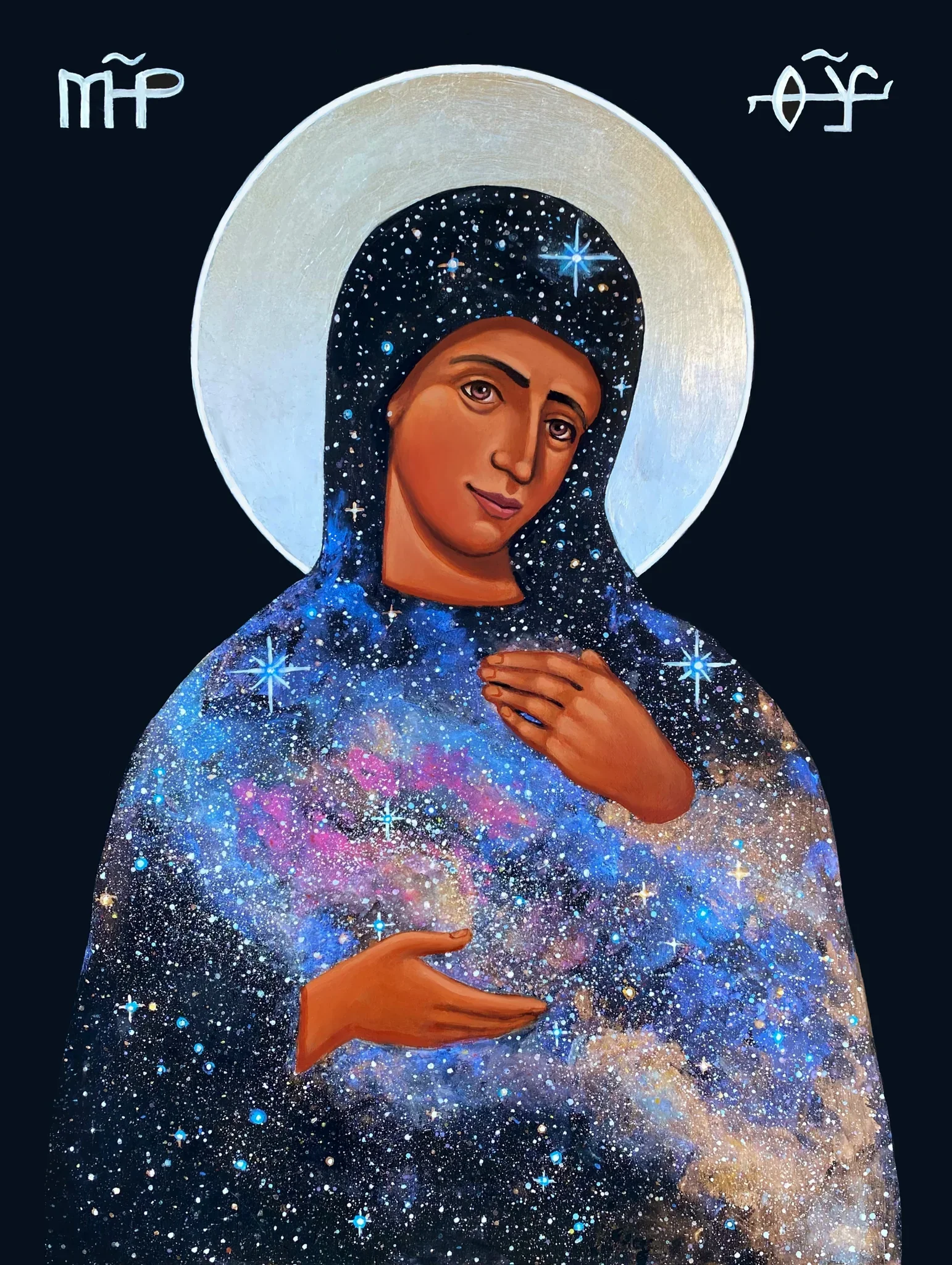
On the cover of this year’s Episcopal Charities Advent appeal is Kelly Latimore’s icon, Mary: Love Forever Being Born. Look at her for a moment. Galaxies drift through the folds of her veil. One hand rests over her heart; the other curves beneath a child she has not yet met. The ancient church called her More Spacious than the Heavens. As with most images of Mary, the “Queen of Heaven,” it is beautiful.
Beauty matters more than we usually admit. Years ago, out of my love for George Steiner, my favorite man of letters, I found a keynote lecture of his, given at the 2010 Nexus Conference: “What’s Next for the West? Superman Meets Beethoven.” I have held onto these words ever since, and I still send them to friends from time to time, because they name so precisely what we all feel when beauty moves us:
“Music, the mystery of music, what Nietzsche called so rightly, ‘the Mysterium Tremendum.’ The Mysterium Tremendum—of the last act of Tristan, and many other cases; it can be an Etude of Chopin, it can be a phrase, almost, in Mozart—speaks to us that there is something else, which paradoxically belongs to us profoundly but somehow touches on universal meaning and possibility: that we are not only an electro-chemical and neuro-physiological assemblage; that there is more in consciousness than electronic wiring.”
Something more. That is the heart of it. For Steiner, beauty is not decoration. It is evidence that we are more than our wiring, and that the deepest part of us is made for a meaning larger than ourselves.
As a pianist, I know that moment when a phrase opens, and the room seems “more spacious than the heavens.” I think we feel the same thing standing before an icon. Mary is beautiful not because she is ornamental, but because her whole life became an open space where God could dwell. She said yes, and the Creator of the stars of night was carried in an ordinary woman’s body.
We need beauty. Not as a luxury, but as our daily bread. When so many of our neighbors are hungry, displaced, frightened, or overlooked, beauty is one way God reminds us that the world is not finished and is not meant to stay as it is. This is the work of Advent.
Mary knew this. Her song, the Magnificat, is one of the most beautiful ever sung, and it is not a lullaby. She sang that the hungry would be filled with good things and the lowly lifted up. Her beauty did not stay inside the frame. It became a longing for justice.
That is what I see in the work of Episcopal Charities, and I mean it when I call it beautiful. This year, through your generosity, we granted $380,000 to seventeen nonprofit partners and $50,000 to eleven Episcopal parishes working to prevent violence, advance equity, care for creation, and end hunger. Through Project P.E.W.S., we walked alongside newly arrived Caribbean and African neighbors whom almost no one else was counting. Six parishes completed energy audits with Eco DioChicago. And our Inner Capacity Building Program tended the souls of the leaders who carry it all. A meal shared, a family seen, a church learning to care for creation: these are beautiful things, as surely as any of Chopin’s Etudes.
Beautiful things need people to sustain them. So this Advent, I am asking for your help. A gift of $250 or more becomes Christ’s tangible mercy in a neighborhood still waiting for it, and every gift, of any size, makes room – as Mary did.
Steiner believed every serious work of art is a kind of gamble on the idea that there is something more. Mary’s yes was that gamble: to carry Emmanuel – God with us. Every gift to this work is a small gamble of our own: that beauty is real, that love is stronger than the darkness, and that the Creator of the stars of night who consented to be carried is still asking us to carry each other, our neighbors, and the most vulnerable among us.
About this series
This reflection is part of More Spacious than the Heavens, Episcopal Charities' 2026 Advent reflection series. Each week, a different voice reflects on the season and its readings.
The series takes its name from our 2026 Advent appeal. The ancient Church gave Mary that title because she made room for God. This year, Episcopal Charities granted $380,000 to seventeen nonprofit partners and $50,000 to eleven Episcopal parishes across the Episcopal Diocese of Chicago, working to prevent violence, advance equity, care for creation, and end hunger.
This Advent, we invite you to make room, too. Read the full appeal, give, and find every reflection in the series at episcopalcharities.org/advent.